
Lets first take a look at creating change. Below are the thoughts and thought process one requires to create sustainable, holistic change within themselves when leading the self, family, community/workplace and the world. If you have any challenges with the mindsets or thought proceesses within the table below. I encourage you to view The Unconscious Mind is the Key to Changing Behaviour blog here.
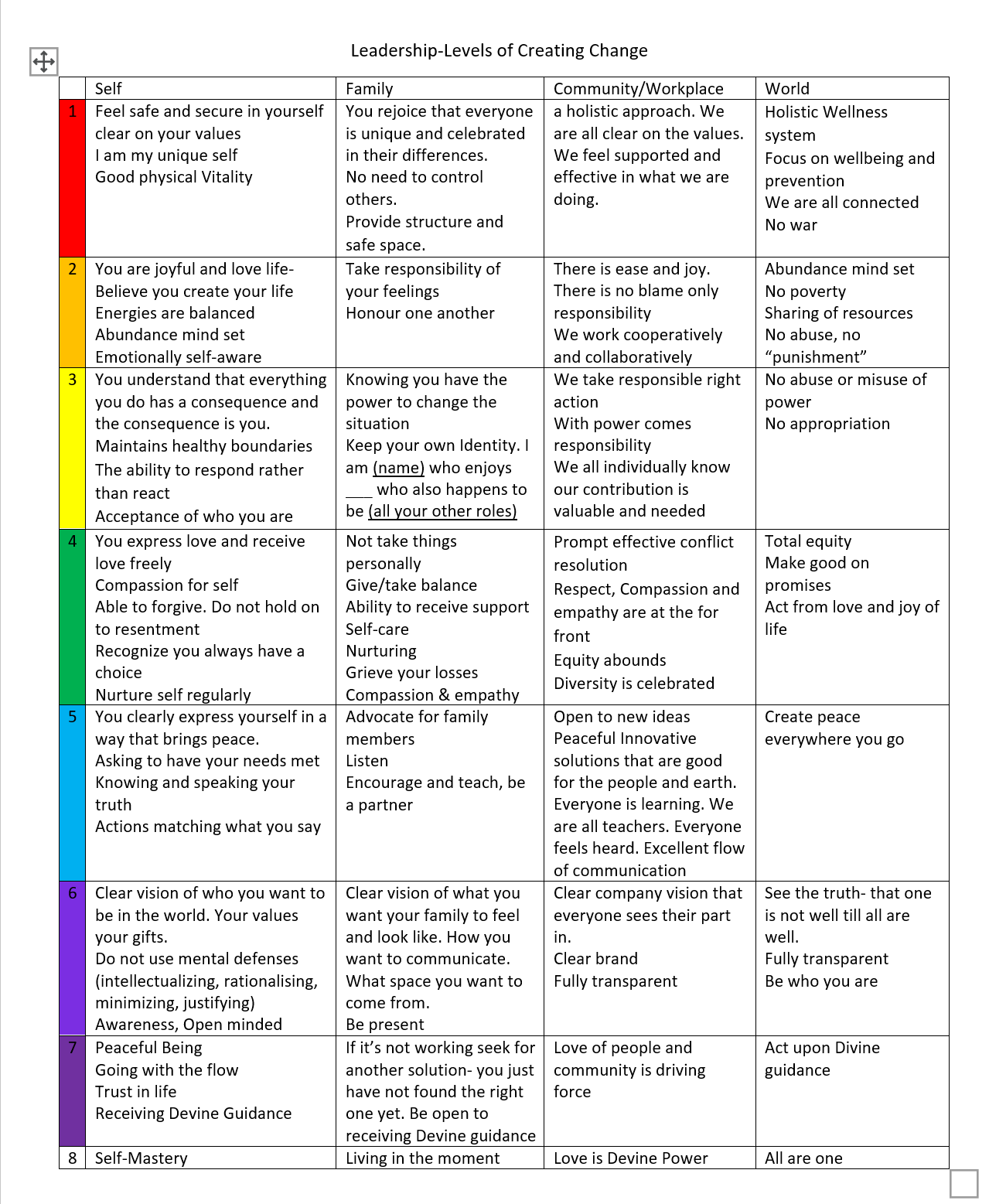
Thought processes for creating change
Change is an inevitable part of every workplace. Whether you're introducing a new wellness initiative, restructuring a team, implementing new technology, or shifting organizational culture, the success of any change effort depends less on the change itself and more on how people experience it.
Too often, organizations focus on the mechanics of change while overlooking the human side of transformation. People need time, understanding, clarity, and support to move from where they are today to where the organization hopes to be tomorrow.
When creating change in the workplace, it can be helpful to use the following six-step framework as a guide.
1. Mindset
Every change begins with mindset.
Before plans are developed or announcements are made, leaders must examine their own beliefs, assumptions, and attitudes about the change. How we think about change influences how we communicate it, implement it, and respond when challenges arise.
A growth-oriented mindset recognizes that change is not something to be managed through control alone; it is a process of learning, adaptation, and collective growth. It also acknowledges that resistance is often not opposition, but valuable information about people's concerns, fears, or unmet needs.
Questions to consider:
Why is this change necessary?
What opportunities could this create?
What assumptions am I making about how others will respond?
How can I approach this process with curiosity rather than judgment?
Creating healthy change begins with cultivating a mindset of openness, empathy, and possibility.
2. Preparation and Vision
People are far more likely to support change when they understand the purpose behind it.
A compelling vision provides direction and meaning. It helps individuals see not only what is changing, but why it matters.
During the preparation phase, take time to clearly define:
The desired future state.
The benefits of the change.
The risks of maintaining the status quo.
The outcomes you hope to achieve.
The resources required for success.
A strong vision serves as an anchor throughout the change process. When challenges arise, the vision reminds people what they are working toward together.
The clearer the vision, the easier it becomes for people to align their efforts and energy.
3. Communication
Communication is not a single announcement—it is an ongoing conversation.
One of the most common reasons change initiatives fail is because people feel uninformed, excluded, or uncertain about what is happening. Effective communication builds trust, reduces anxiety, and creates opportunities for engagement.
Communication should be:
Clear and transparent.
Consistent and frequent.
Two-way rather than one-way.
Honest about both opportunities and challenges.
People need opportunities to ask questions, express concerns, and provide feedback. Listening can be just as important as speaking.
When communication is approached as a dialogue rather than a broadcast, people become active participants in the change rather than passive recipients of it.
4. Implementation
Implementation is where vision becomes action.
This stage involves translating plans into practical steps while remaining flexible enough to adapt as new information emerges.
Successful implementation often includes:
Clear timelines and milestones.
Defined roles and responsibilities.
Adequate training and resources.
Ongoing monitoring and problem-solving.
It is important to remember that implementation is rarely a straight line. Unexpected obstacles, competing priorities, and human emotions are all part of the process.
Organizations that approach implementation with flexibility and responsiveness are better equipped to navigate challenges and maintain momentum.
Progress is often built through small, consistent actions rather than dramatic transformations.
5. Support
Change can be exciting, but it can also be stressful.
As people move through uncertainty, they need support systems that help them adapt and succeed.
Support may include:
Coaching and mentoring.
Training and skill development.
Peer support networks.
Wellness and mental health resources.
Opportunities for reflection and discussion.
Support demonstrates that the organization values its people and recognizes that successful change requires more than new processes—it requires helping individuals feel capable, confident, and connected.
When people feel supported, they are more likely to engage positively with change and contribute to its success.
6. Evaluation and Review
Change is not complete once implementation ends.
Evaluation provides an opportunity to learn, celebrate successes, identify challenges, and make improvements moving forward.
Reviewing the process allows organizations to ask:
What worked well?
What barriers emerged?
What feedback did employees provide?
Were the desired outcomes achieved?
What adjustments are needed?
Continuous improvement transforms change from a one-time event into an ongoing learning process.
The most resilient organizations are those that regularly reflect, adapt, and evolve based on experience.
Change as a Continuous Cycle
Rather than viewing change as a linear project with a clear beginning and end, it can be helpful to see it as a continuous cycle. Mindset influences preparation. Preparation shapes communication. Communication supports implementation. Implementation requires support. Support contributes to successful outcomes. Evaluation informs future mindset and vision.
Each step influences the others.
When approached thoughtfully, change becomes more than a process—it becomes an opportunity to strengthen trust, build capacity, and co-create healthier, more resilient workplaces.
A Call to Action
Take a moment to reflect on a change initiative currently happening within your organization—or one you know is needed.
Which of these six areas is strongest? Which one may need more attention?
Meaningful workplace transformation doesn't happen by accident. It happens when leaders intentionally create the conditions for people to engage, contribute, and grow through change.
Start the conversation. Invite diverse perspectives. Clarify the vision. Strengthen support systems. Most importantly, remember that sustainable change begins with people.
When we co-create change with those affected by it, we don't just improve processes—we create workplaces where individuals, teams, and organizations can truly thrive.
Need help with change management or mindset Book a consultation